
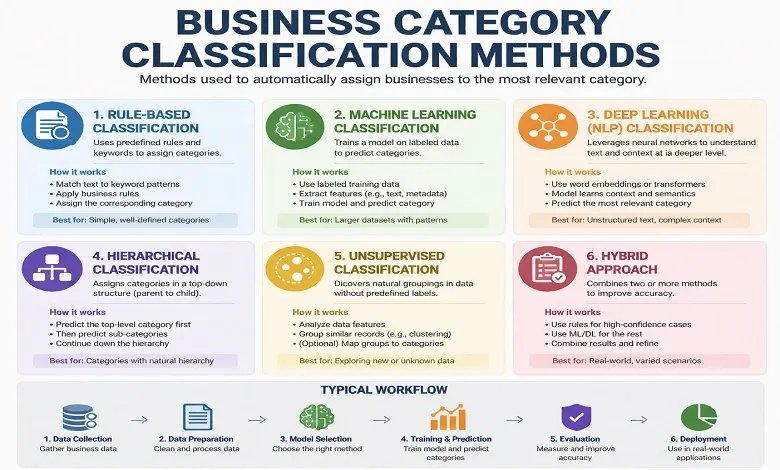
In today’s fast-moving business environment, where companies are constantly evolving and industries are blending into one another, understanding business category classification methods has become more important than ever. Whether you’re running a startup, analyzing competitors, working in marketing, or studying economic trends, the way businesses are categorized plays a crucial role in how information is interpreted and decisions are made.
At first glance, business classification might seem like a technical or administrative concept, something only governments or analysts worry about. But in reality, it affects everything—from how your business is discovered online to how investors evaluate opportunities and how markets are structured.
This guide takes a deeper, more practical look at business category classification methods, explaining not only what they are but also how they work in real-world situations, why they matter, and how they continue to evolve in a digital economy.
What Are Business Category Classification Methods?
Business category classification methods are structured systems used to group businesses based on similarities in their activities, products, services, or operational models. Instead of treating every company as a completely separate entity, these methods organize them into categories so that patterns can be understood more easily.
For example, a company that manufactures clothing will be grouped differently from a company that provides financial services, even if both operate globally. This grouping helps create order in a complex economic system and allows for meaningful comparisons.
What makes these methods particularly useful is that they bring consistency. Without classification systems, analyzing industries or comparing companies would be extremely difficult, especially when dealing with large datasets or global markets.
Why Business Classification Is So Important
The importance of business category classification methods becomes clearer when you look at how widely they are used across different areas of business and research.
Making Market Research More Accurate
When businesses are grouped into clear categories, it becomes much easier to study trends within a specific industry. Analysts can identify which sectors are growing, which are declining, and where new opportunities might exist. Without proper classification, this kind of analysis would be scattered and unreliable.
Helping Businesses Understand Their Position
For business owners and entrepreneurs, classification is not just about labels—it’s about identity. Knowing which category your business belongs to helps you identify your direct competitors, understand your target market, and position your brand more effectively.
Supporting Government and Economic Planning
Governments rely heavily on classification systems to collect data, measure economic performance, and create policies. For example, employment rates, industry growth, and productivity are all analyzed using structured business categories.
Guiding Investment Decisions
Investors often evaluate companies based on the industries they belong to. By using established classification systems, they can compare companies within the same category and make more informed decisions about where to invest their money.
Main Types of Business Category Classification Methods
There is no single universal method that fits every purpose. Instead, several business category classification methods exist, each designed for specific use cases.
1. NAICS (North American Industry Classification System)
One of the most widely used classification systems today is NAICS, especially in North America.
How NAICS Works
NAICS uses a hierarchical structure that assigns businesses a multi-digit code based on their primary economic activity. The more digits in the code, the more specific the classification becomes.
For example, a broad category like manufacturing can be broken down into more detailed segments such as food manufacturing or textile production. This layered approach allows analysts to study industries at different levels of detail, depending on their needs.
Why NAICS Is Important
What makes NAICS particularly valuable is its focus on production processes rather than just end products. This means businesses are grouped based on how they operate, not just what they sell, which provides a more accurate picture of industry dynamics.
2. SIC (Standard Industrial Classification)
Before NAICS became the standard, the SIC system was widely used.
How SIC Works
SIC assigns a four-digit code to businesses, categorizing them into major industry groups and subcategories. While it is simpler than NAICS, it is also less detailed.
Where SIC Is Still Used
Even though it has been largely replaced, SIC codes are still used in certain regulatory and financial contexts. Some organizations continue to rely on it because of its long history and widespread recognition.
3. GICS (Global Industry Classification Standard)
For those involved in finance and investing, GICS is one of the most relevant classification systems.
Structure of GICS
GICS organizes companies into sectors, industries, and sub-industries, creating a global framework that allows investors to compare companies across different markets.
Why Investors Use GICS
This system is particularly useful because it reflects how companies generate revenue, which is a key factor in financial analysis. It helps investors build diversified portfolios and understand risk across different sectors.
4. ICB (Industry Classification Benchmark)
ICB is another globally recognized system, often used by stock exchanges and financial analysts.
Key Features
It categorizes companies based on their primary source of revenue and business activities. While similar to GICS, it offers a slightly different structure, giving analysts another perspective when evaluating industries.
5. Sector-Based Classification
This is one of the simplest and most traditional methods of classification.
The Five Economic Sectors
Businesses are grouped into:
- Primary (natural resources)
- Secondary (manufacturing)
- Tertiary (services)
- Quaternary (knowledge-based activities)
- Quinary (decision-making roles)
Why This Method Still Matters
Even though it is less detailed than modern systems, sector-based classification provides a big-picture view of the economy. It helps explain how different parts of the economy interact with each other.
6. Product-Based Classification
In this method, businesses are grouped based on the products they create or sell.
For example, companies can be classified as:
- Electronics
- Food and beverages
- Automotive
This method is widely used in marketing because it aligns closely with how customers think about products.
7. Market-Based Classification
Market-based classification focuses on the type of customers a business serves.
Common Categories
- B2B (Business-to-Business)
- B2C (Business-to-Consumer)
- D2C (Direct-to-Consumer)
Why It’s Useful
This method is particularly helpful for developing marketing strategies, as it highlights how businesses interact with their customers.
8. Process-Based Classification
Some business category classification methods group companies based on how they operate rather than what they sell.
For example, two companies might sell similar products but use completely different production methods. In such cases, process-based classification provides a more accurate way to distinguish them.
9. Revenue-Based Classification
In modern business analysis, companies are often categorized based on how they generate revenue.
Examples
- Subscription-based businesses
- E-commerce platforms
- Service providers
Why This Method Is Growing
As digital business models become more common, traditional classification systems sometimes struggle to keep up. Revenue-based classification helps fill this gap by focusing on how businesses actually make money.
Challenges in Business Classification
Even the most advanced business category classification methods face certain challenges.
Businesses Are Becoming More Complex
Many companies today operate in multiple industries at once. For example, a tech company might offer software, hardware, and cloud services, making it difficult to assign a single category.
New Industries Are Emerging
Fields like artificial intelligence, fintech, and digital platforms don’t always fit neatly into existing categories. This creates a need for constant updates and revisions to classification systems.
Static Systems vs Dynamic Businesses
Traditional classification systems are often slow to adapt, while businesses evolve rapidly. This mismatch can lead to outdated or inaccurate classifications.
The Future of Business Classification
Looking ahead, business category classification methods are likely to become more flexible and data-driven.
AI and Machine Learning
Advanced algorithms can analyze company data in real time, allowing for more accurate and dynamic classification.
Multi-Dimensional Classification
Instead of assigning a business to a single category, future systems may allow companies to belong to multiple categories simultaneously.
Real-Time Updates
As industries change, classification systems will need to update more frequently to stay relevant.
How to Choose the Right Classification Method
Choosing the right method depends on your purpose.
- For government reporting → NAICS
- For financial analysis → GICS or ICB
- For marketing → Product or market-based classification
Understanding your goal helps you select the most useful approach.
Final Thoughts
Understanding business category classification methods is not just about learning codes or systems—it’s about gaining a clearer picture of how the business world is structured.
These methods help bring order to complexity, making it easier to analyze industries, compare companies, and make informed decisions. As businesses continue to evolve, classification systems will also adapt, becoming more flexible and more reflective of real-world dynamics.
For anyone involved in business—whether as an entrepreneur, analyst, or investor—having a solid understanding of these methods is not just helpful, it’s essential.
FAQs:
Q: What are business category classification methods?
A: They are systems used to group businesses based on activities, products, or economic roles.
Q: Which classification system is most widely used?
A: NAICS is one of the most commonly used systems today.
Q: Why are classification methods important?
A: They help in market analysis, business strategy, and economic research.
Q: Can a business belong to more than one category?
A: Yes, especially in modern business models where companies operate across multiple sectors.
Q: How are classification systems evolving?
A: They are becoming more flexible, data-driven, and capable of handling complex business models.