

Managing investments effectively involves more than simply choosing a few stocks, bonds, or funds. Investors need a clear approach for deciding how assets should be allocated, monitored, adjusted, and protected over time. Structured portfolio management provides a systematic framework that can make these decisions easier to organize and evaluate.
Rather than relying on individual investment decisions made at random, a structured approach connects financial goals with asset allocation, risk management, diversification, and regular portfolio reviews. It can be useful for individuals, families, and organizations looking for a disciplined way to manage their investments.
What Is Structured Portfolio Management?
Structured portfolio management is an organized method of managing a collection of investments according to specific objectives, risk preferences, time horizons, and financial circumstances.
The process typically starts by identifying what an investor wants to achieve. The portfolio can then be designed around those goals, with different asset classes serving different purposes. Stocks may provide long-term growth potential, while bonds or cash-based investments may provide greater stability or liquidity.
The key idea is consistency. Instead of making investment choices based entirely on short-term market movements, investors follow a defined framework and review it periodically.
Why Is Portfolio Structure Important?
A portfolio without a clear structure can become difficult to manage. An investor may unintentionally hold too much of one asset, overlook certain risks, or make decisions based on emotions during periods of market volatility.
A structured approach helps establish clear boundaries for investment decisions. It can answer questions such as:
- What percentage should be invested in different asset classes?
- How much risk is appropriate?
- What is the investment time horizon?
- When should a portfolio be reviewed?
- Under what circumstances should assets be rebalanced?
Having these guidelines can help investors maintain consistency and keep investment decisions connected to their broader financial objectives.
Key Components of Structured Portfolio Management
Several important elements work together when creating a structured investment strategy.
1. Defining Investment Goals
Every portfolio should have a purpose. Goals might include building long-term wealth, generating income, saving for retirement, preserving capital, or preparing for a future financial requirement.
The goal influences nearly every other portfolio decision. A long-term investor may have more flexibility to tolerate short-term fluctuations than someone who expects to use the money within a few years.
2. Understanding Risk Tolerance
Risk tolerance refers to how much investment uncertainty an investor can reasonably accept.
It is important to consider both financial capacity and personal comfort. Two investors with similar incomes may have very different attitudes toward market losses.
Understanding risk can help determine an appropriate combination of growth-oriented and defensive investments.
3. Asset Allocation
Asset allocation is one of the central parts of structured portfolio management. It involves dividing investments among different asset categories.
Common categories include:
- Equities
- Bonds
- Cash and cash equivalents
- Real estate
- Commodities
- Alternative investments
The appropriate allocation depends on the investor’s goals, time horizon, financial situation, and risk profile.
4. Diversification
Diversification involves spreading investments across different assets, industries, regions, or other categories.
Its purpose is to avoid excessive dependence on a single investment or market segment. While diversification cannot eliminate investment losses, it can help reduce the impact that poor performance in one area has on the overall portfolio.
For example, holding investments across several sectors may reduce concentration compared with placing most of the portfolio in one industry.
5. Portfolio Monitoring
A portfolio should not simply be created and ignored. Market conditions, personal circumstances, financial goals, and investment performance can change over time.
Regular monitoring allows investors to identify changes in allocation, risk exposure, and performance. However, monitoring does not necessarily mean making frequent trades. In many cases, the purpose is to determine whether the portfolio still follows its original strategy.
How Does Structured Portfolio Management Work?
A structured portfolio management process can be divided into several practical stages.
Step 1: Assess the Investor’s Situation
The process begins by reviewing financial goals, income, existing assets, liabilities, investment experience, time horizon, and risk tolerance.
This provides the foundation for developing a suitable portfolio structure.
Step 2: Establish an Investment Strategy
Once the investor’s objectives are understood, an investment strategy can be developed. This may define target allocations, diversification requirements, liquidity needs, and acceptable levels of risk.
The strategy should be realistic and specific enough to guide future decisions.
Step 3: Select Appropriate Investments
The next step is choosing investments that fit the strategy. Selection may involve considering factors such as cost, risk, liquidity, diversification, historical performance, and the role of each investment within the portfolio.
An investment should not be selected simply because it performed well recently. Its purpose within the overall portfolio is also important.
Step 4: Monitor Performance
Portfolio performance can be reviewed against relevant objectives and benchmarks. Investors can examine whether returns, risk exposure, and asset allocation remain consistent with the strategy.
Performance should be viewed over an appropriate time period rather than judged solely on short-term movements.
Step 5: Rebalance When Necessary
Over time, some investments may grow faster than others. This can cause the portfolio’s actual allocation to move away from its intended targets.
Rebalancing involves adjusting holdings to bring the portfolio closer to its planned allocation. The timing and method of rebalancing depend on the investor’s strategy and circumstances.
Benefits of Structured Portfolio Management
A systematic approach can offer several practical advantages.
Better Organisation
Investors have a clear framework for understanding what they own and why they own it. This can make portfolio decisions easier to track.
Improved Risk Awareness
By defining risk limits and diversification requirements, investors can become more aware of concentration and exposure within their portfolios.
Greater Consistency
A written strategy can reduce the temptation to make sudden decisions based solely on market headlines or short-term price movements.
Easier Performance Evaluation
When a portfolio has defined objectives and benchmarks, investors can evaluate its progress more meaningfully.
Adaptability
A structured portfolio does not have to remain unchanged. The framework can be reviewed and adjusted when financial goals, market conditions, or personal circumstances change.
Structured Portfolio Management vs. Traditional Investment Management
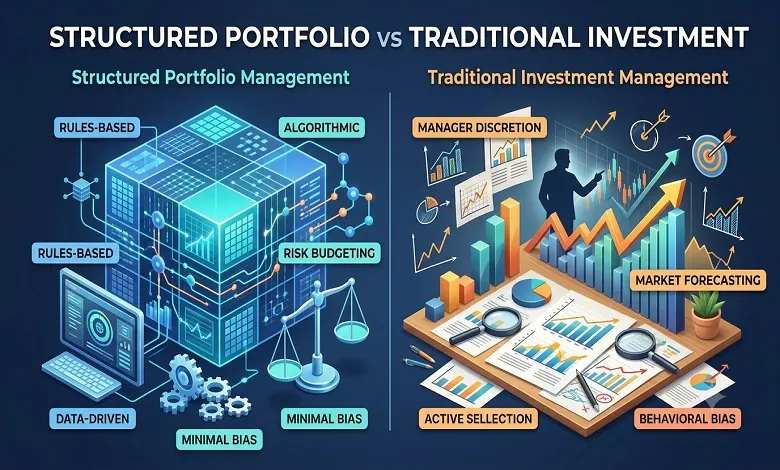
The two approaches can overlap, but the emphasis can be different.
Traditional investment management may focus heavily on selecting and managing individual investments. Structured portfolio management places greater emphasis on the overall framework connecting goals, allocation, risk, diversification, monitoring, and rebalancing.
This does not mean one approach is automatically suitable for every investor. The appropriate method depends on individual circumstances and investment objectives.
The Role of Technology
Technology has changed how portfolios are monitored and managed. Digital investment platforms can provide portfolio dashboards, performance reports, allocation analysis, risk information, and automated rebalancing features.
Data analytics can also help investors understand how different investments contribute to overall portfolio performance.
However, technology does not replace the need for a sound investment strategy. A sophisticated platform cannot compensate for unclear objectives or inappropriate risk assumptions.
Working With a Portfolio Management Firm
Some investors prefer to manage their own investments, while others work with professional advisers or portfolio management firms.
When researching a business described as a structured portfolio management LLC, investors should look beyond the name and examine the firm’s services, regulatory status where applicable, fee structure, investment approach, disclosures, and relevant professional credentials.
The legal structure of a business does not by itself indicate the quality or suitability of its investment services. Investors should conduct appropriate due diligence before giving an individual or firm authority to manage their assets.
Common Mistakes to Avoid
Even with a structured strategy, investors can make mistakes.
Ignoring Investment Costs
Fees, transaction costs, and other expenses can affect long-term returns. Understanding the total cost of an investment is therefore important.
Over-Diversifying
Diversification can be useful, but owning too many similar investments may make a portfolio unnecessarily complicated without providing meaningful additional diversification.
Chasing Short-Term Performance
An investment that has recently performed well may not continue doing so. Decisions should be considered within the context of the overall strategy.
Failing to Review Personal Goals
A portfolio designed years ago may no longer reflect an investor’s current circumstances. Changes in income, retirement plans, major purchases, or time horizon can affect investment requirements.
Reacting Emotionally to Market Volatility
Market prices can move significantly over short periods. Making major portfolio changes solely because of temporary market movements can cause an investor to move away from a carefully designed strategy.
How to Build a Structured Portfolio
Investors who want to create a more organized approach can begin with a few basic steps:
- Define specific financial objectives.
- Determine the investment time horizon.
- Evaluate risk tolerance and financial capacity.
- Establish an appropriate asset allocation.
- Diversify investments across suitable categories.
- Document the investment strategy.
- Review performance periodically.
- Rebalance when the portfolio moves significantly from its intended structure.
- Update the strategy when financial circumstances change.
The exact allocation and investment choices should depend on individual circumstances rather than following a universal formula.
Frequently Asked Questions
Q: What is structured portfolio management?
A. Structured portfolio management is a systematic approach to managing investments using defined goals, asset allocation, diversification, risk controls, monitoring, and rebalancing.
Q: Is structured portfolio management suitable for beginners?
A. It can be useful for beginners because it provides a framework for making investment decisions rather than relying entirely on short-term market movements.
Q: How often should a portfolio be reviewed?
A. There is no single schedule that works for everyone. Many investors review their portfolios periodically and also reassess them after significant changes in financial circumstances or investment objectives.
Q: Does diversification guarantee that an investor will not lose money?
A. No. Diversification can help manage concentration risk, but it cannot eliminate market risk or guarantee a profit.
Q: Should investors manage their portfolios themselves?
A. Some investors prefer self-management, while others seek professional assistance. The decision depends on financial knowledge, available time, complexity, goals, and personal preferences.
Conclusion
Structured portfolio management provides investors with a practical framework for connecting financial goals with investment decisions. By focusing on asset allocation, diversification, risk management, monitoring, and periodic rebalancing, investors can create a more organized approach to managing their portfolios.
The most important principle is to build a strategy around individual circumstances rather than following short-term market trends or copying another investor’s portfolio. Regular reviews can then help ensure that the investment structure continues to reflect changing goals and financial needs.
For investors considering professional assistance, researching the firm’s services, fees, regulatory information, investment philosophy, and disclosures is an important part of the decision-making process.