
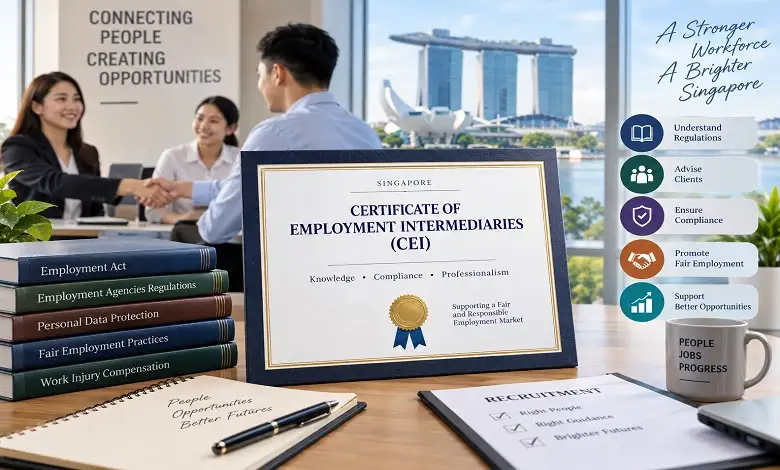
Employment agencies play an important role in connecting job seekers with employers, but they also have responsibilities under employment laws and regulations. In Singapore, the Certificate of Employment Intermediaries (CEI) helps ensure that employment agency personnel understand these responsibilities and can properly advise clients about their rights and obligations.
The CEI is particularly relevant to employment agencies operating under Singapore’s Comprehensive Licence framework. It is designed to improve knowledge of employment regulations, licensing requirements, and good practices within the employment agency industry.
Understanding who needs the certification, what it covers, and how the CEI process works can help employment agency owners, key appointment holders, and agency staff meet their regulatory responsibilities.
What Is the Certificate of Employment Intermediaries?
The Certificate of Employment Intermediaries, commonly called CEI, is a certification designed for personnel working in Singapore’s employment agency industry.
According to Singapore’s Ministry of Manpower (MOM), the purpose of CEI is to equip employment agency personnel with knowledge of employment laws and regulations. This helps them understand their obligations and advise clients about their rights and responsibilities.
The certification is therefore more than a general professional qualification. It is connected to the regulatory framework governing employment agencies in Singapore.
Who Needs a Certificate of Employment Intermediaries?
CEI requirements apply to certain personnel working for employment agencies with Comprehensive Licences.
MOM states that key appointment holders and employment agency personnel doing employment agency work must attain the relevant CEI. Key appointment holders have additional certification requirements before registration.
A simplified overview is:
| Role | CEI Requirement |
| Key appointment holder | CEI required |
| Employment agency personnel performing EA work | CEI required |
| Other agency staff | Requirement depends on their role and applicable regulations |
| Job seeker using an agency | Does not need CEI simply to use an employment agency |
The exact requirement can depend on the agency’s licence type and the individual’s role. Employment agencies should therefore check the latest MOM requirements rather than relying on an old checklist.
Why Does CEI Matter?
Employment agencies deal with important issues such as recruitment, employment contracts, work arrangements, personal information, and relationships between employers and workers. Mistakes in these areas can create legal and operational problems.
CEI helps personnel develop a better understanding of the rules governing employment agency work. This can support more responsible advice and better communication with both employers and job seekers.
The certification also contributes to professional standards within the employment agency sector by requiring relevant personnel to understand applicable legislation and regulatory obligations.
What Does CEI Cover?
The CEI framework covers areas of employment law and regulation that employment agency personnel may encounter in their work.
Training materials for the CEI include subjects such as the Employment Agencies regulatory framework, Employment Act, Work Injury Compensation Act, contract law, fair employment considerations, and personal data protection.
Depending on the relevant CEI module, additional areas can apply to different categories of workers and employment agency activities.
Common Areas Covered by CEI
| Topic | Why It Matters |
| Employment Agencies regulations | Helps personnel understand agency licensing obligations |
| Employment Act | Provides knowledge of important employment requirements |
| Work Injury Compensation | Helps personnel understand workplace injury responsibilities |
| Contract law | Supports proper understanding of employment-related agreements |
| Fair employment principles | Helps agencies advise clients responsibly |
| Personal data protection | Supports appropriate handling of worker information |
| Migrant worker requirements | Important for agencies handling migrant workers |
| Employment agency practices | Helps personnel understand their professional responsibilities |
The specific syllabus can change, so candidates should use current information from MOM or an approved CEI training provider.
CEI for Key Appointment Holders
Key appointment holders have an important role because they are responsible for the general control and management of employment agency work.
MOM describes a key appointment holder as someone in an employment agency who has general control and management of EA work. Candidates must meet eligibility requirements in addition to satisfying the certification requirements.
For agencies operating under the applicable Comprehensive Licence categories, key appointment holders must attain the CEI before registration.
This makes CEI an important part of the compliance process for people responsible for managing an employment agency.
CEI for Employment Agency Personnel
CEI is not limited to agency owners or directors. Employment agency personnel who perform employment agency work may also need to obtain the appropriate certification.
The purpose is to ensure that people directly involved in EA work understand the regulations that apply to their responsibilities. This is particularly important because agency personnel may communicate directly with employers and job seekers about employment matters.
The appropriate CEI type can depend on the person’s position and the type of employment agency work being performed.
What Are the Different CEI Types?
CEI requirements can involve different certification categories designed for different roles.
For example, training and examination providers currently list CEI options for Key Appointment Holders (KAH) and basic employment agency personnel.
The distinction matters because a person managing an employment agency may have different responsibilities from an employee performing day-to-day agency work.
Before registering for a course or examination, candidates should confirm which CEI category applies to their role.
How Does the CEI Test Work?
The CEI certification process involves an examination designed to test knowledge relevant to employment agency work.
Current information from an approved training provider indicates that CEI examinations are conducted using a computer-based format. The available examination types include CEI KAH and CEI Basic, with different schedules and durations.
Candidates can prepare through CEI training courses, although current arrangements may allow certain candidates to attempt the test without first attending a course. The precise rules should be checked before registration because examination policies can change.
Do You Need to Attend a CEI Course?
A training course can be useful for understanding the legislation and regulatory requirements covered in the examination.
Current CEI course information states that participants can take the CEI test without attending the course on one occasion. If they fail that first attempt, they must attend the relevant CEI course before taking the test again.
This means candidates should understand the current examination and training rules before deciding whether to enroll in a preparation course.
CEI and Employment Agency Compliance
CEI should be viewed as one part of broader employment agency compliance.
Having a certificate does not mean that an agency can ignore other licensing conditions or employment regulations. Agencies and their personnel must continue to comply with the requirements that apply to their activities.
For example, employment agencies may need to consider:
| Compliance Area | Example Consideration |
| Agency licensing | Maintain the appropriate licence |
| CEI certification | Ensure relevant personnel hold the required certification |
| Employment laws | Understand applicable statutory requirements |
| Personal data | Handle candidate information appropriately |
| Recruitment practices | Follow applicable agency rules |
| Worker protection | Understand relevant employment protections |
| Record keeping | Maintain required documentation |
CEI provides knowledge, but compliance is an ongoing responsibility.
Benefits of Having CEI-Certified Personnel
CEI can provide several practical benefits to an employment agency.
Better Regulatory Knowledge
Certified personnel have been assessed on employment-related legislation and regulations relevant to their work. This can help them understand their responsibilities more clearly.
More Informed Client Advice
Employment agencies regularly communicate with employers and job seekers. Understanding the applicable rules can help personnel provide more accurate information within the limits of their role.
Stronger Professional Standards
A structured certification requirement encourages employment agency personnel to maintain knowledge of relevant laws and industry requirements.
Reduced Compliance Risk
Knowledge of regulatory obligations can help agencies identify potential compliance issues earlier and handle employment-related matters more carefully.
These benefits depend on how effectively an agency applies the knowledge in its daily operations. A certificate itself should not be treated as a guarantee of perfect compliance.
CEI vs Employment Agency Licence
CEI and an employment agency licence are not the same thing.
An agency licence relates to the legal authorization to operate an employment agency, while CEI is a certification requirement for relevant personnel under the applicable regulatory framework.
| CEI | Employment Agency Licence |
| Applies to relevant agency personnel | Applies to the employment agency |
| Focuses on knowledge and certification | Authorizes regulated agency operations |
| Tests understanding of relevant laws and regulations | Sets conditions for operating the agency |
| Can apply to key appointment holders and EA personnel | Held by the employment agency |
Both can be important components of regulatory compliance.
How to Prepare for the CEI
Preparation should begin by identifying the correct CEI category for your role. Once that is clear, review the current syllabus and examination requirements.
A practical preparation approach includes:
- Check your eligibility and CEI category. Make sure you are preparing for the correct examination.
- Review current MOM requirements. Regulatory requirements can change, so use current official information.
- Study the relevant legislation. Focus on the areas included in your CEI syllabus.
- Use approved training resources. Structured training can help organize the material.
- Practice applying the rules. Understanding how regulations apply to real employment situations is more useful than simply memorizing definitions.
- Check examination procedures. Confirm registration requirements, examination format, and current schedules before booking.
MOM and approved CEI training providers are the best sources for current certification information.
Common Mistakes When Preparing for CEI
Some candidates focus only on memorizing information and overlook the practical application of employment regulations.
Other common mistakes include preparing from outdated study materials, registering for the wrong CEI category, or assuming that requirements have remained unchanged.
Because CEI is connected to Singapore’s employment agency regulatory framework, candidates should always check the latest official requirements before taking the examination.
CEI and Migrant Worker Employment
Singapore’s employment agency framework includes requirements relevant to agencies handling migrant workers and migrant domestic workers.
The CEI programme includes modules covering different worker categories, and specific certification or course requirements can depend on the agency’s licence and the work being performed.
Agencies involved in migrant worker recruitment should therefore make sure their personnel understand the rules applicable to the relevant worker category.
What Happens After Getting CEI?
Obtaining CEI is not the end of an employment agency professional’s compliance responsibility.
Employment regulations can change, and agencies need to keep their practices aligned with current requirements. Personnel should continue learning about regulatory updates and follow the rules applicable to their role.
For agency managers, it is also useful to maintain records showing which employees have the required certification and to review compliance requirements whenever staffing roles or agency activities change.
Final Thoughts
The Certificate of Employment Intermediaries is an important part of Singapore’s employment agency regulatory framework. It helps ensure that relevant agency personnel understand the laws and responsibilities involved in employment agency work.
For employment agency owners, key appointment holders, and agency staff, keeping CEI certification and regulatory knowledge up to date is an important part of maintaining professional and compliant operations. Since requirements can change, always confirm the latest information with Singapore’s Ministry of Manpower before making compliance decisions.
FAQs About Certificate of Employment Intermediaries
Q: What is the Certificate of Employment Intermediaries?
A. The Certificate of Employment Intermediaries, or CEI, is a Singapore certification designed to ensure relevant employment agency personnel understand employment laws, regulations, and their responsibilities.
Q: Who needs CEI certification?
A. For employment agencies operating under applicable Comprehensive Licences, key appointment holders and employment agency personnel performing EA work are required to attain the relevant CEI.
Q: Is CEI required for every employee in Singapore?
A. No. CEI requirements apply specifically to relevant personnel working in employment agencies under the applicable regulatory framework. They do not apply to every employee in Singapore.
Q: Can I take the CEI test without attending a course?
A. Current CEI course information allows a participant to take the test without attending the course once. If the candidate fails that first attempt, course attendance is required before a retest under the stated rules.
Q: Where can I check the latest CEI requirements?
A. Singapore’s Ministry of Manpower provides the official information on CEI eligibility and employment agency requirements. Candidates should check the latest MOM guidance before registering.