
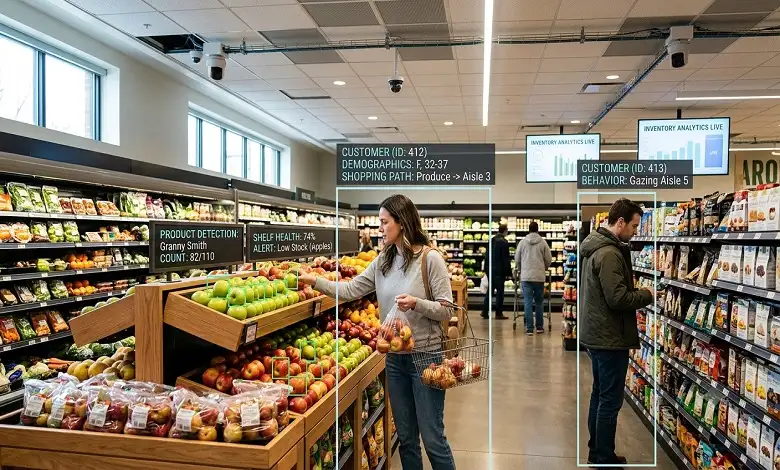
The retail industry has consistently adopted innovation to enhance customer experiences and optimize operations. From barcode scanners to self-checkout kiosks, technology has continually reshaped how businesses serve shoppers. Today, another breakthrough is transforming physical stores and online retail alike—computer vision in retail.
Powered by artificial intelligence (AI), computer vision enables machines to analyze images and videos in real time, helping retailers understand what’s happening inside stores without constant human intervention. Cameras, sensors, and AI models work together to recognize products, monitor shelves, analyze customer movement, reduce losses, and automate routine tasks.
As retailers face rising operational costs, labour shortages, and increasing customer expectations, computer vision is becoming a strategic investment rather than an experimental technology. More importantly, businesses are paying close attention to computer vision retail ROI, evaluating how AI-driven visual intelligence contributes to revenue growth, cost savings, and operational efficiency.
This guide explores how computer vision is transforming retail, the technologies behind it, its real-world applications, and why it has become one of the fastest-growing AI investments in modern commerce. AI-powered retail technologies increasingly combine computer vision, machine learning, automation, and analytics to improve customer experiences and business operations.
What Is Computer Vision in Retail?
Computer vision in retail refers to the use of artificial intelligence that enables computers to interpret and analyze visual information from cameras, images, and video feeds.
Instead of relying solely on employees to monitor shelves or customer activity, AI systems continuously analyze visual data and identify important events automatically.
These systems can detect:
- Products on shelves
- Empty spaces
- Customer movement
- Shopping behavior
- Checkout activity
- Queue length
- Promotional compliance
- Inventory availability
- Potential theft
- Safety concerns
Unlike traditional surveillance systems that simply record footage, computer vision actively understands what is happening and generates actionable insights.
For retailers, this means faster decision-making and improved operational visibility across multiple store locations.
How Computer Vision Works in Retail
Although the technology behind computer vision is sophisticated, the overall process follows several straightforward steps.
1. Image Capture
Retail stores install cameras throughout key areas such as:
- Store entrances
- Checkout lanes
- Product aisles
- Warehouses
- Stockrooms
- Parking areas
These cameras continuously capture images and video streams.
2. AI Processing
Machine learning models analyze every frame to identify:
- Individual products
- Shopping carts
- Customers
- Shelf conditions
- Employee activity
- Store traffic
Unlike simple motion detection, AI recognizes objects based on visual characteristics and learned patterns.
3. Pattern Recognition
The software compares detected objects with trained datasets.
For example, it can determine:
- Which SKU is missing
- Which product is misplaced
- Whether shelves follow the planogram
- If promotional displays are correctly installed
4. Real-Time Alerts
When the system detects a problem, it immediately notifies store employees.
Examples include:
- Empty shelf alerts
- Long checkout queues
- Unauthorized store access
- Product displacement
- Inventory shortages
Immediate notifications allow retailers to resolve issues before they affect customers.
5. Business Analytics
Finally, collected data is transformed into reports that help managers understand:
- Store performance
- Customer traffic
- Inventory trends
- Employee productivity
- Sales opportunities
These insights support smarter business decisions and continuous operational improvement.
Core Technologies Behind Computer Vision in Retail
Several advanced technologies work together to power modern retail computer vision systems.
Artificial Intelligence
AI enables systems to learn from massive amounts of visual data without requiring explicit programming for every scenario.
Machine Learning
Machine learning models improve detection accuracy over time by learning from new images and customer behaviors.
Deep Learning
Deep neural networks recognize complex visual patterns, allowing systems to distinguish between thousands of different products.
Edge Computing
Instead of sending every video frame to cloud servers, edge devices process data locally.
Benefits include:
- Faster processing
- Lower latency
- Reduced bandwidth costs
- Better privacy
Edge processing is increasingly used in retail environments to deliver real-time insights while reducing cloud dependency.
Cloud Computing
Cloud platforms store historical data, generate dashboards, and enable enterprise-wide analytics across multiple store locations.
Internet of Things (IoT)
Computer vision often integrates with smart shelves, RFID readers, digital price tags, and environmental sensors to create a connected retail ecosystem.
Top Use Cases of Computer Vision in Retail
Retailers are applying computer vision across nearly every aspect of store operations.
Smart Shelf Monitoring
One of the most valuable applications is automatic shelf monitoring.
AI continuously checks shelves to identify:
- Out-of-stock items
- Incorrect product placement
- Empty shelf space
- Missing price labels
- Planogram violations
Instead of waiting for manual inspections, employees receive instant alerts when action is needed.
This improves product availability while reducing lost sales caused by stockouts.
Automated Inventory Management
Traditional inventory counts require significant labour.
Computer vision automates this process by tracking inventory visually throughout the day.
Benefits include:
- Improved inventory accuracy
- Faster replenishment
- Reduced manual counting
- Better warehouse visibility
Automated inventory visibility is one of the leading practical applications of computer vision in retail today.
Checkout-Free Shopping
One of the most exciting innovations is cashierless shopping.
Customers simply:
- Enter the store
- Pick desired products
- Leave without visiting a checkout counter
Computer vision tracks selected items and automatically processes payment.
This technology significantly reduces waiting times while improving customer convenience. Checkout-free experiences rely on computer vision working alongside AI and sensor technologies to identify products customers take from shelves.
Queue Management
Long checkout lines negatively affect customer satisfaction.
Computer vision monitors queue length in real time.
When congestion increases, managers receive alerts to open additional checkout counters before customers become frustrated.
Loss Prevention
Retail shrink remains a major challenge worldwide.
Computer vision helps reduce losses by identifying:
- Suspicious shopping behavior
- Unauthorized access
- Product concealment
- Checkout anomalies
- Restricted-area violations
Unlike conventional surveillance systems, AI highlights unusual events that require staff attention.
Customer Behavior Analysis
Understanding customer behaviour is essential for improving store performance.
Computer vision analyzes:
- Walking paths
- Time spent in aisles
- Product interactions
- Heat maps
- Shopping patterns
These insights help retailers optimize store layouts and merchandising strategies.
Planogram Compliance
Retailers invest heavily in shelf layouts designed to maximize sales.
Computer vision automatically verifies whether products are displayed according to the approved planogram.
Store teams can quickly correct misplaced products and maintain consistent merchandising standards.
Retail Execution for Consumer Brands
Consumer packaged goods (CPG) companies also benefit from computer vision.
Field representatives can photograph store shelves, and AI instantly analyzes:
- Product availability
- Shelf share
- Competitor placement
- Promotional displays
- Facing counts
This eliminates hours of manual auditing and improves retail execution accuracy. AI-powered shelf recognition has become one of the most commercially mature computer vision applications for retail and CPG brands.
Benefits of Computer Vision in Retail
Retail organizations adopting computer vision report improvements across multiple business areas.
Key benefits include:
- Better inventory visibility
- Reduced stockouts
- Improved customer satisfaction
- Faster checkout experiences
- Lower operational costs
- Enhanced employee productivity
- Better merchandising compliance
- Reduced shrinkage
- More accurate demand forecasting
- Data-driven decision making
These advantages contribute directly to stronger business performance, making computer vision an increasingly attractive investment.
Why Retailers Are Focusing on Computer Vision Retail ROI
While the technology is impressive, retailers ultimately measure success through business outcomes. That’s why computer vision retail ROI has become one of the most important topics in AI adoption.
Organizations no longer ask whether computer vision works—they ask whether it delivers measurable value. Leading retailers evaluate ROI by examining improvements in inventory accuracy, reduced labor costs, fewer stockouts, higher sales from better shelf availability, lower shrinkage, and enhanced customer experiences. Industry adoption is increasingly shifting from technology pilots to measurable business outcomes.
Understanding Computer Vision Retail ROI
As AI adoption grows, retailers are shifting their attention from technology itself to measurable business outcomes. This is where computer vision retail ROI becomes essential.
Return on investment (ROI) measures whether implementing computer vision delivers financial and operational benefits that outweigh the cost of deployment. Retailers evaluate ROI by comparing implementation expenses with improvements in sales, labor efficiency, inventory accuracy, and customer satisfaction.
Unlike traditional technology investments that may take years to demonstrate value, many computer vision solutions begin generating measurable improvements within months when deployed for high-impact use cases such as shelf monitoring, checkout optimization, and loss prevention. Industry guidance increasingly emphasizes focusing on operational actions that follow AI insights rather than technology alone.
Key Metrics for Measuring Computer Vision ROI Retail
Calculating computer vision ROI retail requires identifying performance indicators that directly affect profitability.
Inventory Accuracy
Poor inventory visibility often leads to stockouts or excess inventory.
Computer vision continuously monitors shelves, helping retailers maintain accurate stock levels while reducing unnecessary replenishment.
Common KPIs include:
- Inventory accuracy percentage
- Out-of-stock rate
- Shelf availability
- Replenishment speed
Sales Growth
Products cannot be sold if they are missing from shelves.
By detecting empty shelves in real time, computer vision helps ensure products remain available for purchase, increasing sales opportunities.
Retailers frequently monitor:
- Revenue growth
- Same-store sales
- Product availability
- Promotion effectiveness
Labor Productivity
Store employees spend significant time performing repetitive visual inspections.
Computer vision automates many of these tasks, allowing staff to focus on customer service and higher-value responsibilities.
Typical measurements include:
- Labor hours saved
- Store productivity
- Task completion time
- Operational efficiency
Shrink Reduction
Retail shrink includes theft, fraud, administrative errors, and inventory loss.
Computer vision identifies suspicious activities and operational issues much earlier than traditional monitoring methods.
KPIs may include:
- Shrink percentage
- Theft incidents
- Fraud detection rate
- Loss prevention savings
Customer Experience
Modern shoppers expect fast, convenient, and frictionless experiences.
Computer vision improves customer satisfaction by reducing waiting times, keeping products available, and simplifying checkout.
Businesses often evaluate:
- Customer satisfaction (CSAT)
- Net Promoter Score (NPS)
- Average queue time
- Checkout speed
- Customer retention
What Is a Computer Vision Retail Intelligence Platform?
As retailers deploy computer vision across multiple stores, they require centralized systems capable of collecting, analyzing, and presenting data from thousands of cameras and sensors.
A computer vision retail intelligence platform serves as the central hub where visual insights become actionable business intelligence.
Instead of viewing isolated camera feeds, retailers receive real-time dashboards showing store performance across an entire retail network.
These platforms combine computer vision with artificial intelligence, analytics, cloud computing, and reporting tools to provide a comprehensive view of operations.
Key Features of a Computer Vision Retail Intelligence Platform
Modern retail intelligence platforms include a wide range of capabilities designed to improve decision-making.
Real-Time Store Monitoring
Managers can instantly monitor:
- Shelf conditions
- Inventory availability
- Customer traffic
- Queue length
- Store occupancy
AI-Powered Analytics
Advanced dashboards transform visual information into business insights such as:
- Sales trends
- Heat maps
- Product interactions
- Customer flow analysis
- Conversion opportunities
Automated Alerts
Rather than constantly reviewing camera footage, employees receive notifications when predefined events occur.
Examples include:
- Empty shelves
- Long checkout lines
- Safety incidents
- Stock shortages
- Unauthorized access
Multi-Store Performance Tracking
Large retail chains can compare store performance using standardized metrics across multiple locations.
This enables regional managers to identify underperforming stores and replicate best practices from high-performing locations.
Predictive Insights
By combining historical and real-time data, AI platforms help retailers anticipate future challenges such as demand spikes, staffing requirements, and inventory shortages.
Latest Computer Vision Retail News and Industry Trends
The latest computer vision retail news shows that the technology is moving rapidly from pilot projects to enterprise-wide deployment.
Several trends are shaping the future of AI-powered retail.
Checkout-Free Shopping Continues to Expand
Cashierless shopping experiences continue to evolve, with computer vision helping create faster and more convenient purchasing journeys.
Customers increasingly expect frictionless shopping experiences that minimize waiting times and reduce unnecessary interactions.
AI-Powered Shelf Intelligence
Retailers are investing heavily in AI systems capable of identifying:
- Missing products
- Incorrect pricing
- Shelf compliance issues
- Promotional execution gaps
Real-time shelf intelligence improves product availability while supporting more effective merchandising strategies.
Warehouse Automation
Computer vision is no longer limited to retail stores.
Distribution centers increasingly use AI-powered vision systems for:
- Package identification
- Inventory tracking
- Quality inspection
- Order verification
Omnichannel Integration
Retailers now combine in-store computer vision with e-commerce analytics to create a unified customer experience.
This integration allows businesses to better understand purchasing behavior across physical and digital channels.
Privacy-Focused AI
As AI adoption grows, retailers are placing greater emphasis on responsible data handling, transparency, and privacy protection.
Many newer computer vision solutions use edge processing, anonymized analytics, and privacy-by-design approaches to reduce unnecessary collection of personally identifiable information while maintaining operational insights. Privacy, fairness, and transparency continue to be important considerations for AI deployment in retail.
Challenges of Implementing Computer Vision in Retail
Despite its many advantages, successful implementation requires careful planning.
Initial Investment
Deploying cameras, AI software, networking infrastructure, and analytics platforms can require significant upfront investment.
However, organizations typically focus on long-term efficiency gains rather than short-term costs.
Data Quality
Computer vision performs best when trained using high-quality images collected under various lighting and store conditions.
Poor image quality can reduce detection accuracy.
System Integration
Retailers often need to integrate computer vision with:
- POS systems
- Inventory software
- ERP platforms
- CRM systems
- Warehouse management software
Proper integration ensures that AI insights translate into operational actions.
Employee Training
Technology alone does not guarantee success.
Store teams must understand how to respond effectively to AI-generated alerts and recommendations.
Privacy and Compliance
Retailers should establish clear governance policies regarding camera usage, data storage, customer privacy, and regulatory compliance.
Transparent communication helps build customer trust while reducing legal risks.
Best Practices for Maximizing Computer Vision Retail ROI
Organizations achieve the strongest results by following a structured implementation strategy.
Begin with High-Impact Use Cases
Start with areas that offer measurable improvements, such as:
- Shelf monitoring
- Inventory management
- Queue optimization
- Loss prevention
Define Clear Success Metrics
Measure results using business KPIs rather than technology metrics alone.
Focus on:
- Revenue growth
- Labor savings
- Inventory accuracy
- Customer satisfaction
Integrate AI Across Business Systems
Computer vision becomes more valuable when connected with inventory, supply chain, merchandising, and customer analytics platforms.
Continuously Improve AI Models
Regular retraining helps AI adapt to:
- New products
- Seasonal displays
- Store layout changes
- Customer behavior
Balance Innovation with Ethics
Retailers should adopt AI responsibly by implementing strong security measures, minimizing unnecessary data collection, and communicating clearly about how visual data is used.
Conclusion
The rapid advancement of computer vision in retail is reshaping how businesses manage stores, serve customers, and make operational decisions. What was once viewed as an emerging AI technology has become a practical solution for improving inventory management, reducing shrinkage, streamlining checkout, and delivering more personalized shopping experiences.
Equally important is understanding computer vision retail ROI. Successful retailers are no longer investing in AI simply because it is innovative—they are adopting solutions that generate measurable business value. Whether through higher sales, lower operating costs, improved labour productivity, or better customer satisfaction, computer vision ROI retail continues to demonstrate why visual AI has become a strategic priority.
At the center of this transformation is the computer vision retail intelligence platform, which turns millions of visual data points into actionable insights that help retailers optimize operations across entire store networks. Combined with ongoing developments highlighted in computer vision retail news, including AI-powered shelf intelligence, warehouse automation, and privacy-focused analytics, the technology is poised to play an even greater role in the future of commerce.
Frequently Asked Questions
Q: What is computer vision in retail?
A. Computer vision in retail uses artificial intelligence to analyze images and video from cameras, helping retailers monitor inventory, customer behavior, store operations, and security in real time.
Q: How does computer vision improve retail ROI?
A. It improves ROI by reducing labor costs, minimizing stockouts, increasing sales, improving inventory accuracy, preventing losses, and enhancing customer experiences.
Q: What is a computer vision retail intelligence platform?
A. A computer vision retail intelligence platform combines AI, analytics, cloud technology, and visual data to provide retailers with real-time operational insights and decision-support tools across multiple locations.
Q: Why is computer vision important for modern retailers?
A. It automates repetitive tasks, improves operational visibility, enables faster decision-making, and supports data-driven retail strategies in increasingly competitive markets.
Q: Is computer vision only useful for large retailers?
A. No. Small and medium-sized retailers can also benefit from applications such as inventory monitoring, queue management, and customer analytics by adopting solutions that match their scale and budget.